
At some point every fleet owner faces the same question about an ageing machine: put money into it, or replace it. The honest answer is that it depends on where the wear actually is — and the machines people replace too early are often the ones that were cheapest to save.
Start with the structure, not the hours
Hour meters are a poor guide on their own. A machine on 12 000 hours that has been greased properly and worked on clean ground can be in better condition than one on 6 000 hours that has spent its life in abrasive material with stretched service intervals.
The question that actually matters is whether the structural core is sound: the chassis, the boom and arm, the main frame and the mounting points. Those are the components that are expensive or impossible to restore. Nearly everything else — pins, bushes, wear plates, hydraulic components, seals, paint — is consumable in the long run and can be brought back.
If the structure is sound, refurbishment usually wins the arithmetic. If the structure is cracked, fatigued or has been repeatedly repaired badly, replacement starts to look sensible no matter how good the rest of the machine is.
What refurbishment typically covers
A meaningful refurbishment is more than a repaint. On a working machine it generally includes:
- Structural inspection and repair. Crack detection and proper weld repair at load-bearing points, rather than cosmetic patching.
- Pins, bushes and bores. Restoring the joints so the front end is tight again, which often means line boring worn bores back to true.
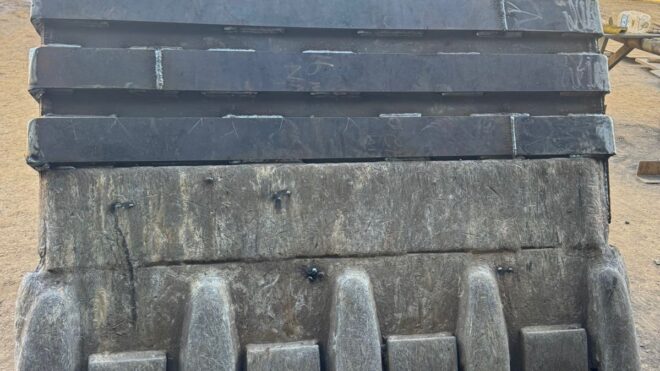
- Wear components. Bucket edges, teeth, wear plates and ground-engaging tools built back up or replaced.
- Hydraulic attention. Cylinder seals, rods, hoses and any component showing drift or internal leakage.
- Finishing. Surface preparation and coating, which matters more than it sounds because it is what stops the corrosion cycle starting again.
The factors that push the sum towards refurbishment
- You know the machine history. A machine you have operated and serviced yourself is a known quantity. A replacement bought second-hand is not, and a used machine can arrive with exactly the problems you were trying to escape.
- Replacement lead times are long. If a new machine is months away, a refurbished machine working next month may be worth more than a better machine later.
- Imported equipment carries currency exposure. For South African operators, replacement pricing on imported machines moves with the exchange rate. Refurbishment is largely local labour and materials, which makes it easier to budget.
- Capital is constrained. Refurbishment is typically a fraction of replacement cost and can often be staged across a shutdown window rather than committed in one go.
The factors that push it towards replacement
- Structural fatigue. Cracks that keep returning after repair are telling you the parent material is tired.
- Parts availability. If major components are obsolete or on long back-order, every future breakdown becomes an extended outage.
- Cumulative failures. When engine, transmission and hydraulics all need major work at once, the combined bill starts approaching replacement value.
- Changed requirements. If the machine no longer suits the work — wrong size, wrong configuration, wrong reach — restoring it just preserves a poor fit.
A practical way to run the numbers
Compare the total refurbishment cost against the realistic replacement cost, then divide each by the working hours you expect to get out of it. A refurbishment that costs a quarter of replacement and returns half the remaining life is a clearly good decision. One that costs two-thirds of replacement and returns a third of the life is not.
Include downtime on both sides of the comparison. Refurbishment has a known, schedulable downtime window. An ageing machine limping along has unscheduled downtime, which is always the more expensive kind.
Get an honest assessment first
The decision rests almost entirely on the structural inspection, so that is the step worth paying proper attention to. A thorough assessment tells you whether you are looking at a refurbishment, a rebuild, or a machine that has genuinely reached the end of its economic life.
RP Strategies provides earthmoving equipment refurbishment in South Africa for excavators, dozers, loaders and graders, including structural weld repair, on-site line boring and full rebuild work.